I was recently looking at the 2025 Profile of Home Buyers and Sellers from the National Association of REALTORS® (NAR), and one number stopped me in my tracks: 40.
That is now the median age of a first-time homebuyer in the U.S.
Just five years ago, that age was 33. In the 1980s, it was the late 20s. We are no longer looking at a market of “kids” figuring it out as they go. We are looking at a market of established, tech-literate, and deeply pragmatic adults who have had to wait a decade longer than their parents to enter the game.
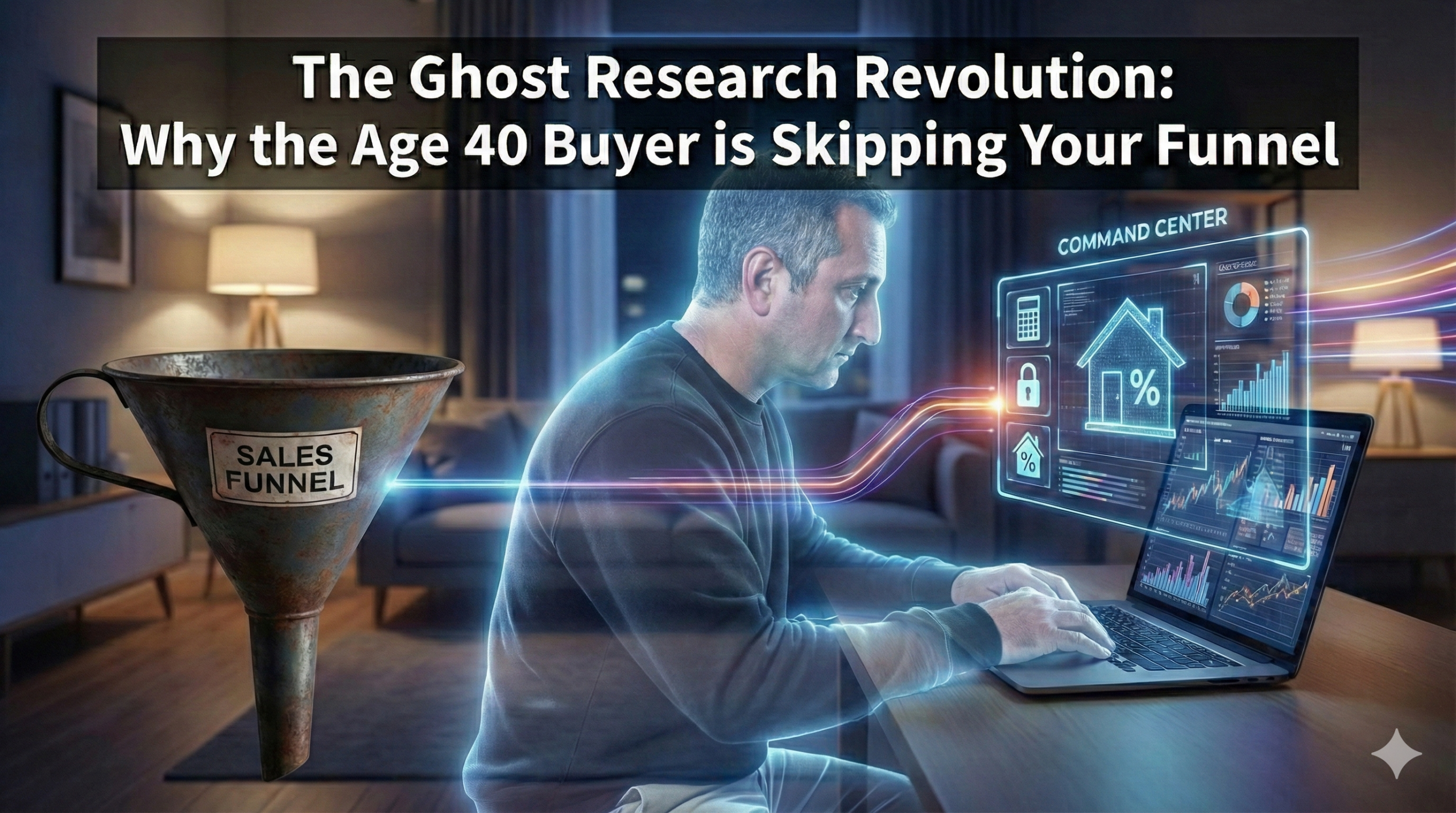
When I layer this over recent McKinsey research on the “Pragmatic Consumer,” a very clear picture of 2026 consumer behavior emerges. It’s a behavior we call “Ghost Research,” and it happens at what we call the Point-of-Research. This is the invisible window where trust is won or lost before a lead ever hits your CRM.
Observation 1: The “Self-Clearance” Phase
McKinsey’s data shows that consumers are spending more time “alone and online” before making large financial decisions. For a 40-year-old first-time buyer, the research phase isn’t about browsing pretty pictures of kitchens. It’s a high-stakes audit of their own life.
I’m seeing a trend where borrowers aren’t looking for a “professional to tell them what to do.” Instead, they are using digital tools to “clear” themselves. They want to know, privately and with high-fidelity math, if their specific scenario actually works before they ever risk a phone call.
Observation 2: Utility is the New Credibility
In previous cycles, “credibility” was a professional headshot and a few testimonials. But for a buyer who has spent 15 years in the workforce, those are table stakes.
According to Deloitte’s 2025 Digital Consumer Trends, there is a massive shift toward “digital empowerment.” Consumers now judge a professional’s expertise by the quality of the tools that professional provides. If a mortgage website offers a generic, 3-field calculator, it sends a signal to a 40-year-old researcher that the advice behind it might be equally shallow.
The most successful digital experiences right now don’t try to “capture” the lead; they equip the lead. They provide sophisticated modeling tools, like those seen on Goalee or Vonk-powered platforms, that allow the user to play out complex “what-if” scenarios.
Observation 3: The Death of the Passive Referral
We used to think of referrals as a name and a phone number. But in a market dominated by “intentional” researchers, the referral has changed.
The “referral” is now often a digital artifact. It’s a borrower texting a spouse or a friend a link to a specific calculator or a city-specific research page. The tool itself is the recommendation. The professional who provided the tool is seen as the expert who “made the math make sense.”
The Bottom Line
The data is telling us that the 2026 homebuyer is the most educated, most cautious, and most tech-dependent in history.
They aren’t looking for a “funnel” to fall into. They are looking for a command center where they can finalize their own discovery. In this environment, your website is the first 20 minutes of your consultation, happening at 11:00 PM on a Tuesday without you ever saying a word.
If your platform isn’t solving for the Point-of-Research, you aren’t just losing leads; you’re becoming invisible to the modern buyer.
Related Posts