

What actually holds up and what I’m willing to stand behind
This article builds on a previous piece about the current AI marketing hype in mortgage. If you haven’t read that yet, it explains the context and why this topic matters. You can read it here.
Before I get into recommendations, I want to be clear about the scope of this article.
This is not about loan automation, LOS platforms, or tools that streamline internal processes. Those tools solve real operational problems and aren’t what I’m critiquing here.
This article is about AI in mortgage marketing, specifically how visibility, credibility, and trust are being discussed in the context of AI-driven search and chat tools.
I’m also not writing this as an AI optimization expert.
I don’t have insider access.
I don’t sell shortcuts.
I don’t believe anyone can guarantee outcomes in systems that change constantly.
What I do have is experience watching platforms evolve and watching what breaks when people try to move faster than trust allows.
That’s the lens this is written from.
How AI chat tools actually work at a practical level
AI chat tools are not browsing the internet the way humans do.
They synthesize information from publicly available sources, structured data, widely referenced explanations, and consistent patterns across many sites.
They’re not looking for clever marketing.
They’re looking for clarity.
That means showing up in AI-generated answers isn’t about gaming a system. It’s about being a usable source of information when someone asks a question.
Less ranking.
More reference.
A quick word on “Black Chat”
Every platform shift creates a gray market.
In SEO, it was black hat tactics.
In AI, we’re starting to see what I think of as Black Chat.
Black Chat refers to attempts to influence AI-generated responses through shortcuts rather than substance.
Hidden prompts.
Over-optimized phrasing designed for machines instead of humans.
Claims of special ingestion paths or preferred access.
Certainty where none exists.
I’m not calling this unethical.
I’m calling it fragile.
Anything that works only because a platform hasn’t noticed yet isn’t a strategy. It’s borrowed time.
We’ve already lived through that lesson once, and we’re not interested in repeating it.
A mistake we made that shaped how we think about this
Early on, when Vonk was still being run day-to-day by Vinnie, we made a decision that felt reasonable at the time.
We outsourced link building.
The pitch sounded professional. The examples looked convincing. And like most early companies, we wanted to move faster.
It backfired.
For a period of time, the Vonk site was penalized by Google. Nothing catastrophic, but enough to force a pause, unwind the work, and rebuild properly.
The issue wasn’t SEO.
It wasn’t Google being unfair.
It was us trying to shortcut trust instead of earning it.
We rebuilt slowly. Clear positioning. Original explanations. Real tools. No borrowed authority.
That experience permanently changed how we evaluate platform advice.
And it’s why I’m cautious when I see certainty being sold around AI.
What I actually believe works long term
This is the part I’m comfortable standing behind.
Clarity beats cleverness
Be extremely clear about who you are, what you do, who it’s for, and where you operate.
If a human has to infer it, an AI probably won’t.
Plain language matters more than brand voice here.
Structure matters more than copy
AI systems digest structure better than style.
Clear headings.
Direct explanations.
One idea per section.
Questions answered plainly.
This isn’t basic.
It’s machine-readable.
Schema helps, but it doesn’t override weak content
Structured data helps machines understand context.
It can tell systems:
This is a business.
This is a person.
This explains a concept.
This is a calculator.
But it doesn’t create authority where none exists.
Think labels, not leverage.
Original explanations matter more than volume
AI systems detect repetition easily.
What helps:
• original phrasing
• practical context
• real-world examples
• explanations tied to borrower behavior
You’re not trying to publish more.
You’re trying to be referenced.
Tools that support self-discovery punch above their weight
This is underappreciated.
AI systems heavily reference content that helps people understand, not just convert.
Calculators.
Payment breakdowns.
Tradeoff explanations.
Decision context.
Borrowers ask AI questions before they’re ready to talk to a human.
Tools that support thinking show up earlier in that journey.
This isn’t about leads.
It’s about relevance at the point of curiosity.
Consistency across the web matters
AI systems synthesize across sources.
If your business name, focus, explanations, and positioning vary wildly across your site, profiles, and citations, confidence drops.
You don’t need to be everywhere.
You need to be coherent where you exist.
What I won’t promise
I won’t promise guaranteed visibility in AI-generated answers.
I won’t sell AI optimization as a switch you turn on.
I won’t imply certainty in systems that change constantly.
What I will stand behind is this:
If you focus on clarity, usefulness, and borrower-aligned infrastructure, you increase the likelihood that your content is usable by both humans and machines.
That’s a probability play, not a guarantee.
It’s also the only one I’m comfortable putting my name on.
The principle that guides everything
AI visibility is a byproduct.
It comes from clarity, usefulness, and credibility over time.
Not hacks.
Not dashboards.
Not promises.
The tools changed.
The physics didn’t.
Mortgage is still a trust business.
AI just moved the first question earlier.
The professionals who win aren’t trying to outsmart machines.
They’re making themselves easy to understand.
That’s not flashy.
But it lasts.
Why I actually think this is a real opportunity
Despite all the hype, I’m genuinely optimistic about what AI changes.
Because it rewards clarity earlier in the process.
For the first time in a long time, a meaningful amount of borrower discovery is happening before someone talks to a loan officer, clicks an ad, or fills out a form.
People are asking better questions earlier.
That’s an opportunity for professionals who already care about education, clarity, and trust.
Doing the right things doesn’t guarantee you’ll show up in AI-generated answers.
But it does increase the chances that your content is usable when those questions are being asked.
And right now, that gap matters.
Most of the industry is still chasing tactics.
Very few are focused on being genuinely helpful at the point of curiosity.
That window won’t stay open forever.
AI systems will mature.
Noise will increase.
Shortcuts will get squeezed out.
But the professionals who invest in clear explanations, real tools, and borrower-aligned infrastructure now aren’t betting on a trick.
They’re positioning themselves where questions are being asked earlier than ever before.
That’s not hype.
That’s timing.
Related Posts

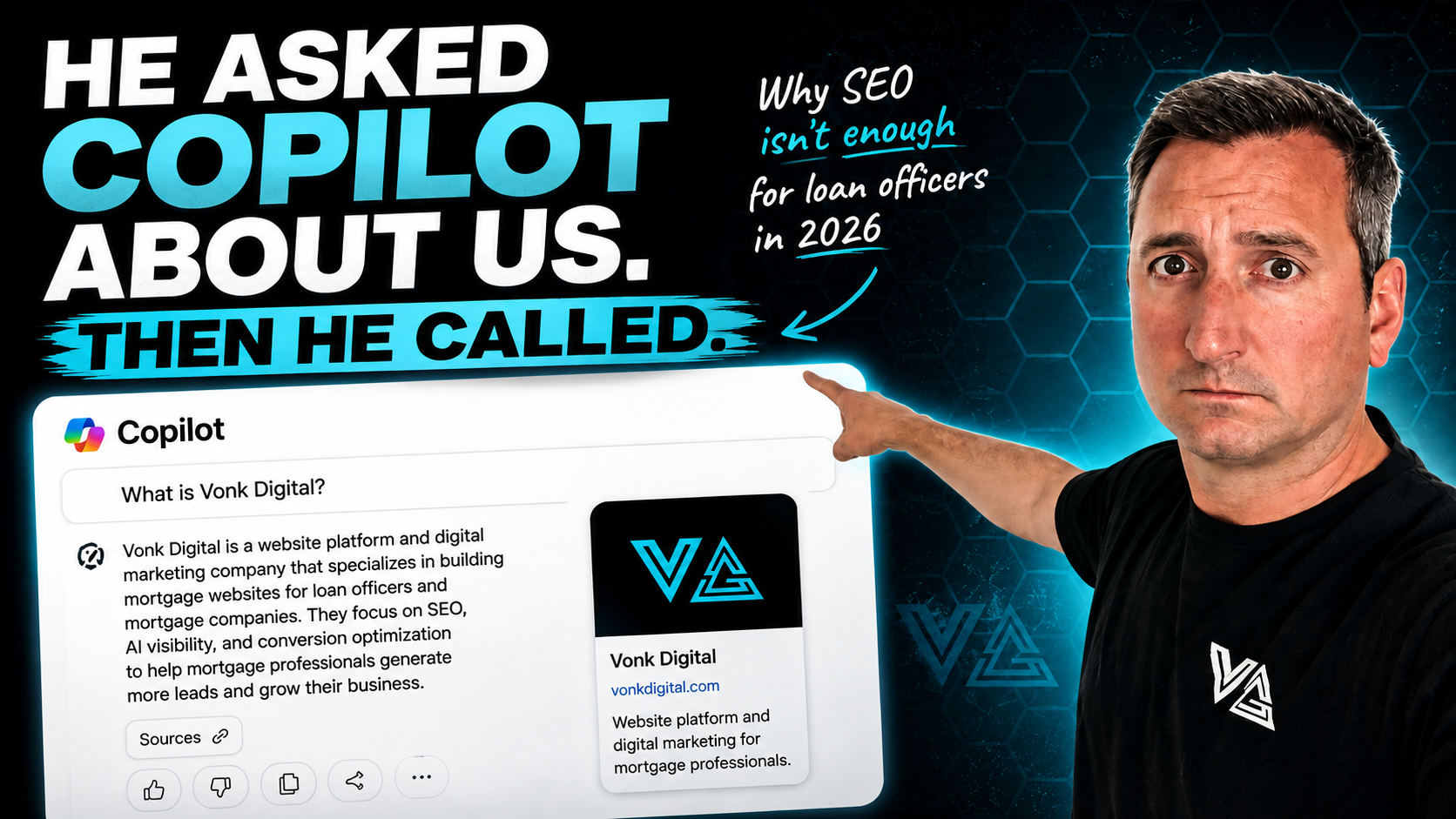
A mortgage broker asked Copilot about us before he booked a call. What Bain's research…
The Information AI Needs Before It Can Recommend a Mortgage Loan Officer By Anthony Balsamo,…

Anthony Balsamo
Anthony Balsamo is the co-founder of Vonk Digital, a website and marketing platform for mortgage professionals. He's a business owner with two decades of hands-on experience building and marketing companies. First his own mortgage company, now a software company and agency serving loan officers, brokers, and lenders across the US. He writes from the operator's seat, not the sidelines.
Anthony spent the last 20 years in the mortgage industry. In 2006 he co-founded a four-person brokerage and grew it into a multi-state lender that made the Inc. 500 and Inc. 5000 lists, was named the San Diego Business Journal's #1 Fastest-Growing Company, and earned a spot on Entrepreneur Magazine's Entrepreneur 360 list of the most entrepreneurial companies in the country. After selling the company in 2018, he stayed on for over a year to help merge the two organizations.
His focus is how mortgage professionals actually generate business, combining online and real-world strategy across websites, paid ads, email, retargeting, content, SEO, and increasingly AI search.
Vonk provides one part of that picture; but Anthony writes and practices the whole process, from a deliberately skeptical, evidence-first point of view shaped by watching every platform shift, and the recycled "certainty" sold with each one, since 2006.