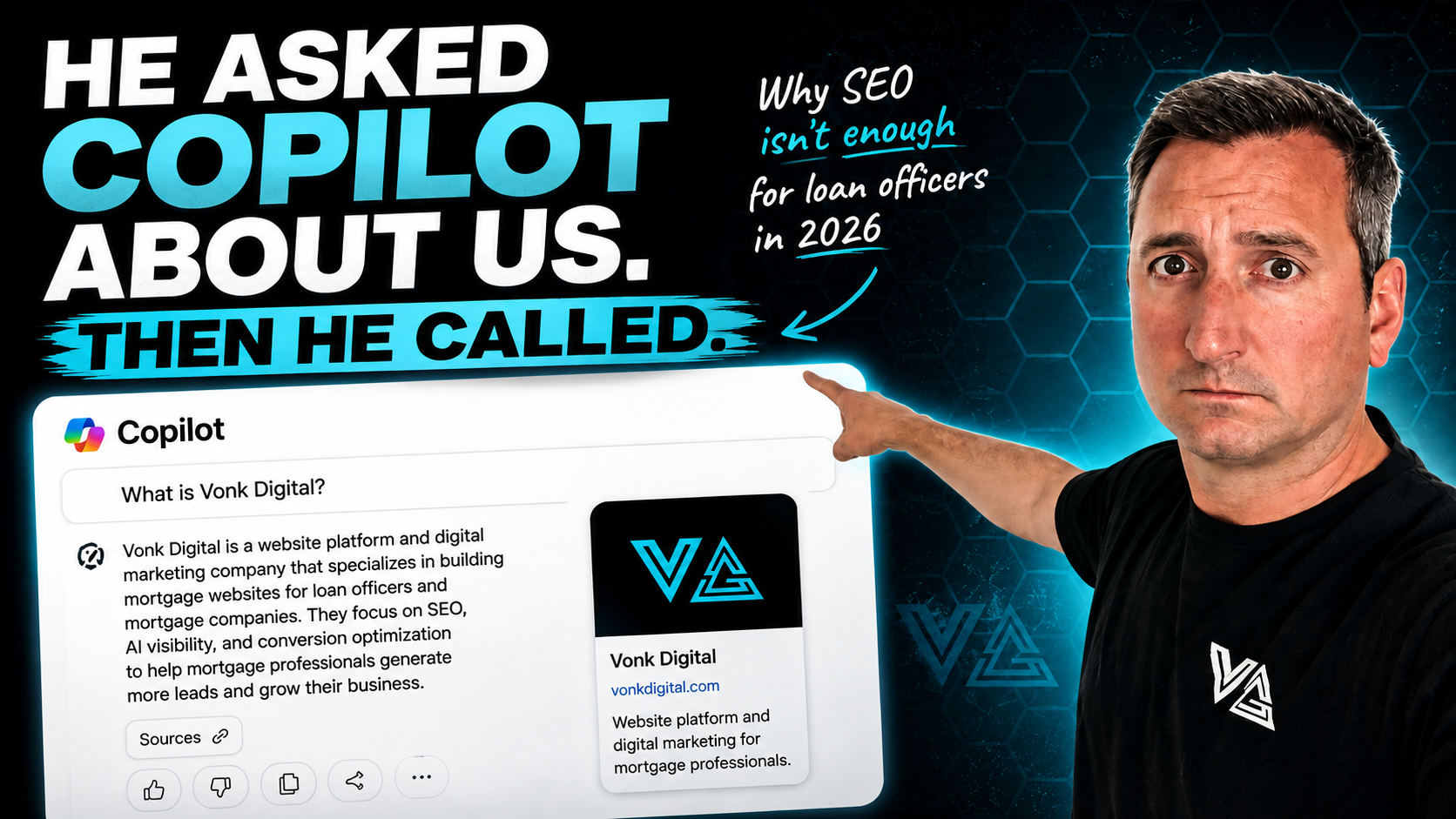
A mortgage broker asked Copilot about us before he booked a call. What Bain’s research says about that, what it doesn’t say, and why mortgage is exposed differently than e-commerce.
Short answer: no. Traditional SEO still gets your site indexed, crawlable, and eligible to appear, and that eligibility is now the entry fee for a second system sitting on top of it. AI answer engines don’t rank ten blue links for a borrower. They read, summarize, and recommend one name, sometimes three. Bain & Company’s April 2026 research calls classic search optimization “necessary but not sufficient.”
The question changed from “where do I rank” to “what does the machine say about me when someone asks.” Those have different answers. A site can rank on page one for your own name and still give an AI engine nothing useful to say about you.
A mortgage broker asked Copilot about us. Then he booked a call.
Last week a broker booked time with me. Before he booked it, he asked Microsoft Copilot about Vonk Digital. He liked what it told him. He said so on the call, unprompted.
The call happened after the research, not before it. By the time we were talking, the decision to talk had been made somewhere I wasn’t present, by a machine summarizing whatever it could find about us.
If that summary had been thin, or wrong, or missing, there’s no call. No objection to handle. No follow-up sequence to run. Just silence, and I never know it happened.
That’s not a forecast about where this is heading. It happened on a Tuesday.
What does Bain’s data say about AI and search?
Bain & Company surveyed 1,500 online buyers in September 2025 and published the findings on April 7, 2026. Three points matter here:
- 44% of surveyed online buyers now mostly start inside an LLM, or split their search between AI tools and traditional search engines.
- On classic search, Bain’s conclusion: “Classic search optimization, search marketing, and lower-funnel conversion tactics become necessary but not sufficient.”
- Bain’s recommendation to brands: “Revamp on-site content strategy for LLM readability and top prompt and category coverage, ensuring that high-quality structured content is available, fresh, and crawlable.”
Roughly half of the buyers Bain surveyed said they trust generative AI for initial research and product comparisons. Read the Bain report.
What does Bain’s data not say?
It doesn’t say anything about mortgage.
Bain surveyed online buyers. That’s retail and e-commerce behavior. Nobody has published a clean number on what share of borrowers vet a loan officer inside an AI tool before reaching out, and I’m not going to pretend otherwise.
So don’t walk into a branch meeting and say 44% of borrowers use ChatGPT to find loan officers. That isn’t what the study says, and someone will check.
Why is mortgage exposed differently than e-commerce?
E-commerce is a discovery problem. Somebody wants running shoes and doesn’t know which brand.
Mortgage is mostly a validation problem. The business comes from referrals. An agent sends a client your way. A past borrower gives your name to a coworker. The name arrives with trust already attached.
Then that person looks you up.
We call that gap the Point of Research™: the window between the referral and the first contact, when someone who already has your name goes looking for reasons to feel good about it, or reasons not to.
That lookup used to be Google and your reviews. Increasingly it’s a prompt. “Is [name] a good loan officer in [city]?” The engine answers with whatever it can assemble.
Here’s the honest version of the argument, since I just spent a section telling you not to over-claim from someone else’s data. I can’t prove borrowers are doing this at scale. What I can say is that the structure of the risk is different in mortgage than in retail. In retail, a weak AI presence costs you a stranger who was never going to be yours. In mortgage, it costs you a referral that was already yours, at the moment it was being handed over.
You never see that loss. It shows up as a referral partner who quietly stops sending, and you assume they got busy.
What is the difference between SEO and AEO?
SEO optimizes for ranking in a list of links. AEO, or answer engine optimization, optimizes for being the source an AI engine quotes when it gives a single answer.
| Traditional SEO | AEO | |
|---|---|---|
| Goal | Rank in a list of links | Be quoted in one answer |
| Metric | Position and clicks | Citations and mentions |
| Unit of content | The page | The passage |
| What wins | Keywords, links, domain authority | Specific facts, clean structure, a verifiable identity |
| Who’s looking | Someone searching for a service | Someone who already has your name |
They aren’t opposites. AEO sits on top of SEO. If a crawler can’t fetch your page, no amount of structure saves you.
What do AI answer engines look for on a page?
We build and run websites for hundreds of mortgage professionals, and we watch AI crawler behavior across those sites in Vonk Insights. Four patterns hold up. We go deeper on this in the information AI needs before it can recommend a loan officer.
Unique content from real experience. Recycled market updates and rewritten national articles get skipped. Engines filter for content that exists in one place.
Structure a machine can lift. Headings phrased the way a person asks the question, with a direct answer underneath. Not a wall of prose an engine has to guess at.
Density of real facts. Named programs. The counties you actually lend in. Specific numbers, sourced and dated. Vague authority language is unquotable, and unquotable means uncited.
Consistency over time. One good page does nothing. A site publishing credible, specific, dated content week after week builds a pattern the engines learn to trust.
Two technical notes that get missed, because they’re the part nobody selling you an “AI SEO hack” wants to explain:
- Most AI crawlers run zero JavaScript. GPTBot, PerplexityBot, and ClaudeBot don’t execute it. If your bio, your loan products, or your NMLS number load client-side, they’re invisible to the engines you’re trying to appear in. Only Google’s crawler renders.
- A lot of mortgage websites are blocking the crawlers on purpose. We audited 18 mortgage sites, including our own. Several had robots.txt files disallowing GPTBot, ClaudeBot, and Google-Extended, the crawler that grounds Google’s AI Overviews and Gemini. Nobody chose that. It shipped in a template.
Neither of those is a trick, and there’s no schema tag that fixes them. What we do see is that crawler activity tracks publishing frequency long before citations show up.
Want to know what your own site is telling the engines right now?
Run the free AI Visibility Check
Takes about a minute. No call attached to it.
Why doesn’t this get done?
Read Bain’s recommendation again: “revamp on-site content strategy for LLM readability.”
That sentence was written for a company with a marketing department. You’re a loan officer. You already have a job, and it involves borrowers, agents, underwriters, and a phone that doesn’t stop.
Over the last decade the industry quietly stacked five more jobs on top of yours. Content creator. Social media manager. Tech operator. SEO specialist. Now AI prompt strategist. Every one of them arrived as advice, and every one of them arrived as work you have to do yourself.
That’s why it never compounds. Knowing what to do and having a system that does it are different things, and the industry keeps selling the first one.
Our mantra is short: no new homework.
If a marketing solution depends on your personal execution every week, it will fail.
What does it look like when the website does the work?
The Authority Plan turns the website into the thing doing the publishing, instead of the thing waiting on you to publish.
What it does:
- Launches or relaunches your site on current layouts
- Publishes 3 custom posts per week to your site, in your market and your niche, in your voice
- Structures that content for both traditional search and AI answer engines
- Covers local SEO for your market and the surrounding areas
- Builds loan program pages and local market pages with real specifics
- Tracks AI crawler activity, live ChatGPT fetches, confirmed AI clicks, and top-cited pages in Vonk Insights
What it asks of you:
- About 15 minutes in a setup wizard
- Nothing after that
It’s the output of an SEO agency without the agency cost, built only for mortgage. We don’t split attention across restaurants and dentists. Mortgage is the whole business.
Frequently asked questions
Does traditional SEO still matter if AI is answering the questions?
Yes. AI engines pull from crawlable, indexed web content. If your site is invisible to a crawler, it’s invisible to the model. SEO is the foundation the AI layer sits on. It just isn’t sufficient on its own.
What is AEO, and how is it different from SEO?
SEO optimizes for ranking in a list of links. AEO, or answer engine optimization, optimizes for being the source an AI engine quotes when it gives a single answer. SEO wants clicks. AEO wants citations.
How do I find out what AI says about me right now?
Ask it. Open ChatGPT, Copilot, Gemini, and Perplexity and ask each one whether you’re a good loan officer in your city, and who it would recommend. Use a fresh session so your own history doesn’t skew the result. Whatever comes back is what your next referral is seeing. Here’s what that looks like in practice, or run our free AI Visibility Check and we’ll pull it for you.
Can my website be blocking AI crawlers without me knowing?
Yes, and it’s common. Visit yourdomain.com/robots.txt and look for lines disallowing GPTBot, ClaudeBot, PerplexityBot, or Google-Extended. Those blocks usually arrive inside a website template rather than by choice. A site that blocks them cannot be cited, regardless of how good the content is.
How long does it take to show up in AI search results?
There’s no fixed timeline, and anyone quoting one is guessing. Engines re-crawl on their own schedule and weigh consistency over time. Across our client sites, crawler activity responds to publishing frequency well before citations do.
I already have a Vonk Digital website. Is this already handled?
Partly. Your site is crawlable, it’s structured, and your NMLS renders as visible text, which is what makes citation possible at all. That part is handled. What a website alone doesn’t include is custom content. Outside the Authority Plan we aren’t publishing unique, market-specific posts to your site every week, and that’s the part the engines weigh most. A well-built site with nothing new on it is a site with nothing to quote. The foundation is there. The engine isn’t running. Ask us about upgrading.
Can a loan officer do AEO themselves?
Technically yes. The requirements are public. The failure point is sustaining a weekly publishing operation for years while running a pipeline. If you’ve done that consistently for the last twelve months, you don’t need us.
Borrower research happens whether you participate or not
Somebody is going to ask a machine about you this month. The machine is going to answer. Your only decision is whether it has anything credible to work with.
I’ll walk you through what your site is currently telling the engines.
Anthony Balsamo, Co-Founder, VonkDigital.com | Goalee.io. Pro model websites and mortgage calculators for the mortgage industry. Vonk Digital has built websites for mortgage professionals since 2011.
Source: Bain & Company, “Your Next Customer Will Find You Using AI. Now What?” April 7, 2026. Survey of 1,500 online buyers, September 2025.
Related Posts