The Information AI Needs Before It Can Recommend a Mortgage Loan Officer
By Anthony Balsamo, founder of Vonk Digital. Published August 2026.
A borrower gets referred to you by a real estate agent. Or they see your name on social media. Or a friend mentions you.
Then they open ChatGPT, Gemini, or Google and start asking questions:
- “Who can help a first-time buyer in [city]?”
- “Can I get approved if I’m self-employed?”
- “Who is experienced with VA loans near me?”
- “What mortgage professional can help me understand down-payment assistance?”
- “Which loan officers have strong reviews and work with buyers like me?”
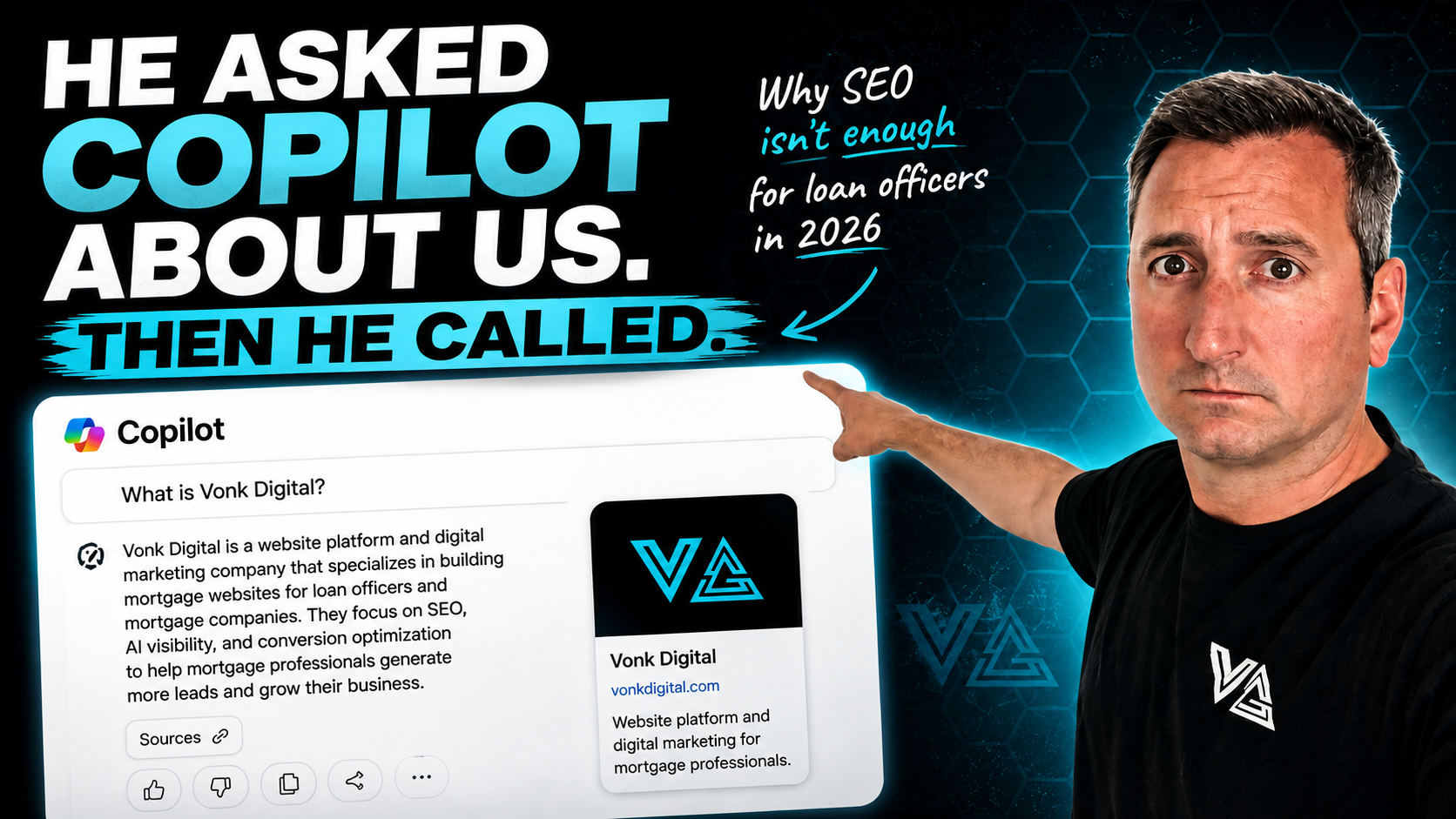
Before they ever call, fill out a form, or reply to your text, they may use AI to decide whether you even belong on their shortlist. We call that moment the Point of Research, and it happens whether you participate in it or not.
That is the shift every mortgage professional needs to understand. Bain & Company found that about 80% of search users rely on AI-generated summaries for at least 40% of their searches, and that about 60% of searches on traditional search engines now end without the user clicking through to a single website.
This is not a reason to panic. It is a reason to make sure the public information about your business is clear enough for borrowers, and the AI tools they use, to actually understand who you are and who you help.
AI is part of discovery, not a replacement for you
Let me be clear about what is not happening. AI is not replacing the need for a real loan officer.
A borrower cannot get personalized advice, verified pricing, required disclosures, or a real lending strategy from a generic AI answer. They still need a qualified professional to help them weigh options and move through one of the biggest financial decisions of their life.
But AI is now a bigger part of the phase that happens before a borrower ever reaches out. McKinsey reports that nearly half of consumers already use AI-based search to help with activities along their purchase decision journey.
For us, that means a borrower may use AI to:
- Learn what loan options might fit their situation
- Compare FHA, conventional, VA, USDA, jumbo, or refinance options
- Understand how self-employment, credit, debt, or a down payment affects qualification
- Research local professionals before deciding who feels credible enough to contact
- Turn a referral into a shortlist
So the question is not “Will AI replace my Google leads?” The better question is this: if a borrower asks AI who can help with their exact situation, is there enough accurate information out there for your business to be understood and included?
Being visible is not the same as being understood
Being online is not the same as being understandable.
You might have a website, a social profile, a Google Business Profile, and a few reviews, and still leave the big questions unanswered. A borrower may not be able to tell where you are licensed, who you help, what scenarios you know cold, or why they should feel confident picking up the phone.
McKinsey puts the change plainly: “Being visible is no longer enough; brands must be ‘consumable’ and trusted by machines.”
That does not mean you chase AI hacks, flood your site with generic content, or promise that ChatGPT will recommend you. It means the information that makes you credible has to be present, specific, consistent, and easy to find. I call the work of supplying that information feeding the machines.
Six things AI needs to understand about you
When a borrower asks a detailed question, AI tools need reliable information to connect that question to a relevant professional. Here are six areas every loan officer should make clear online.
1. Who you are
Your online presence should make your identity unmistakable. Include your full professional name, company or brokerage, NMLS ID, role, photo, credentials, and compliant licensing disclosures. Keep those details consistent across your website, Google Business Profile, major directories, and social profiles.
If your name, company, phone number, or licensing details change from one place to the next, it gets harder for both people and machines to confidently understand your business.
2. Where you serve borrowers
“Serving your mortgage needs” tells a borrower nothing. They should be able to quickly see:
- The states where you are licensed
- The cities, counties, or communities where you actively work
- Whether you work remotely, locally, or both
- Any markets where you have real, meaningful experience
A borrower asking “Who can help me buy a home in [city]?” needs to see a clear line between their location and your business.
3. Whom you help
Most loan officers try to appeal to everyone. In practice, being specific wins.
If you regularly help first-time buyers, move-up buyers, veterans, self-employed borrowers, investors, retirees, doctors, or people relocating into your market, say so clearly, as long as it is accurate. A borrower may not ask for “a mortgage lender.” They ask, “Who understands self-employed income in Austin?” or “Who can help a first-time buyer understand FHA loans in Tampa?”
Make it easy to understand the borrower situations you are actually equipped to help with.
4. What you have experience helping with
This is not about broad promises or claiming every loan type fits every borrower. It is about straightforward education on the scenarios and questions that come up in your business. For example:
- FHA versus conventional financing for first-time buyers
- VA loan basics for eligible service members and veterans
- What self-employed borrowers can expect during documentation
- How down-payment assistance generally works in your market
- What to think through before refinancing
- What to prepare before getting pre-approved
Google’s own guidance for generative AI search is not to write content for the machines. It recommends useful, unique, people-first content that reflects real expertise. In its words, “Creating content that people find unique, compelling, and useful will likely influence your website’s presence in generative AI search.”
In other words: do not publish 100 generic mortgage articles. Publish fewer, stronger pages that answer the questions your real borrowers ask.
5. Why borrowers should trust you
Mortgage lending is a trust decision. Borrowers want to know the person they contact is experienced, responsive, and able to explain a complicated process without making them feel foolish or pressured.
Show proof where appropriate: verified client reviews, years of experience, credentials and affiliations, local-market knowledge, educational content based on real borrower questions, a clear explanation of your process, and your community or referral-partner relationships.
This is exactly what the research points to. McKinsey describes the need for “credibility signals” that machines can read and validate, such as verified reviews and expert input. Gartner’s Alan Antin puts the content standard the same way: companies “will need to focus on producing unique content that is useful,” and it “should continue to demonstrate expertise, experience, authoritativeness and trustworthiness.” AI visibility and borrower trust are not separate goals. They are the same goal.
6. How a borrower can take the next step
A borrower may finally decide you seem like the right person to talk to, then leave because the next step is not obvious.
Every important page should make it easy to see what happens next: schedule a call, request a consultation, start a secure application, ask a question, download a helpful guide, or learn what documents to prepare. The best mortgage websites do not shove people into an “instant quote” funnel. They make it easy to move forward when the borrower is ready.
The AI visibility test
Here is a simple test for your online presence. Imagine a borrower asks an AI assistant:
“I’m a first-time buyer in [your market]. I have questions about down-payment assistance and want a loan officer who will explain my options clearly. Who should I talk to?”
Now ask yourself:
- Is it clear where I serve borrowers?
- Is it clear that I work with first-time buyers?
- Is there useful information on my site about the questions they are likely asking?
- Can someone see legitimate proof that past clients trusted me?
- Are my business details, licensing, and contact information consistent everywhere?
- Is there an obvious next step if the borrower wants to talk?
If the honest answer is “not really,” the problem is bigger than AI search. Your business is probably hard for any borrower to understand and trust during the research phase.
What not to do
As AI search becomes normal, plenty of companies will sell you shortcuts. Be careful. You do not need to:
- Create dozens of thin pages targeting every possible question
- Stuff pages with awkward keywords or repeated city names
- Buy fake reviews or inauthentic mentions
- Fill your site with generic AI-written content
- Promise borrowers rates, approvals, or terms you cannot back up
Good fundamentals still win. Publish helpful information, keep your facts accurate and consistent, structure your site so it is easy to read and verify, and give borrowers a clear path to a real conversation.
Your website is your public explanation
Bain & Company summed up the change this way:
“AI-generated search results are rewriting the rules, and SEO optimization is no longer enough.”
— Natasha Sommerfeld, Partner, Bain & Company
For loan officers, that does not mean SEO is dead. It means your website cannot just be a digital business card or a place to dump ad traffic. It has to clearly explain who you are, who you help, where you work, what questions you can help borrowers navigate, why people should trust you, and how to start a conversation.
When a borrower uses AI to research their options, the goal is not to manipulate the answer. The goal is to make sure the answer has enough accurate, credible information to understand why you are worth contacting.
That is the whole job. It is also real, ongoing work, and you already have a job that needs your attention. It is exactly the work we do for mortgage professionals, so you get found without it becoming one more thing on your plate.
Want to see how we handle it for you, so you get found without the homework?
Sources
- Bain & Company, “Consumer Reliance on AI Search Results Signals New Era of Marketing,” February 19, 2025.
- McKinsey & Company, “From Campaigns to Continuous Growth: AI Capabilities Shaping Marketing,” June 22, 2026.
- Gartner, “Gartner Predicts Search Engine Volume Will Drop 25% by 2026, Due to AI Chatbots and Other Virtual Agents,” February 19, 2024.
- Google Search Central, “Google’s Guide to Optimizing for Generative AI Features on Google Search,” 2026.
Related Posts