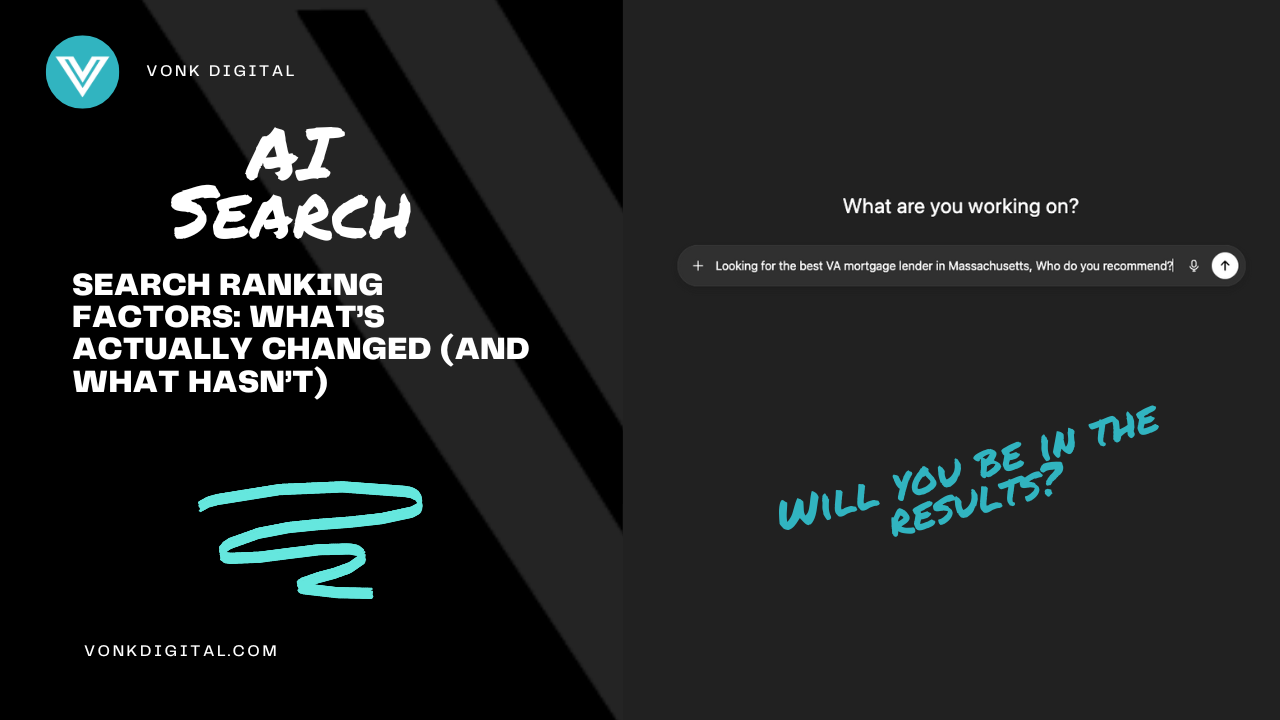
AI Search Ranking Factors: What’s Actually Changed (and What Hasn’t)
There’s been a lot of noise lately about AI taking over search — and what it means for SEO. The truth is, most of the fundamentals haven’t really changed. Search engines, whether human-driven or AI-powered, still reward websites that are clear, trustworthy, and technically sound. What’s different is how these systems read and interpret that information. That is the take-away here.
In this article, we’ll break down what actually matters for ranking in the era of AI Search, what hasn’t changed at all, and how Vonk Digital is already helping mortgage professionals stay ahead with smarter website structure and built-in schema tools.
The Evolution of Search
Search has always been about delivering the best answer to the user. What’s changed over the past decade is the way search engines determine what “best” means. Google and now AI systems like ChatGPT, Gemini, and Perplexity rely less on keywords and more on understanding intent, trust, and expertise.
For years, Google has been quietly preparing for this shift. Updates like Hummingbird, RankBrain, and BERT were all steps toward interpreting natural language, not just matching words. Today’s AI Search continues that evolution — it just reads and summarizes results instead of listing dozens of links.
Common Terms in AI Search
| Term | Meaning | Usage Context |
|---|---|---|
| AI Search | Search powered by large language models (LLMs) that summarize or answer directly instead of listing links. | Used broadly by Google, OpenAI, Microsoft, and SEO leaders. Most recognized and neutral term. |
| Generative Search | AI that generates summaries or insights rather than returning traditional search listings. | Common in Google’s “AI Overviews” and SEO industry discussions. |
| AI Overviews (AIO) | Google’s branding for its AI-generated summaries inside search results. | Used in Google’s public messaging and documentation. |
| Search Generative Experience (SGE) | The original name for Google’s AI Overviews during beta testing. | Still referenced by SEO professionals, now largely replaced by AIO. |
| LLM Search | Search results created by large language models like ChatGPT, Gemini, or Perplexity. | Mostly used in technical SEO and AI development circles. |
| Conversational Search | Two-way, natural language interactions where users “ask” and AI “responds.” | Used in user-experience and interface design discussions. |
| AI Discovery | How AI systems help users find and recommend brands or professionals beyond traditional search results. | Increasingly used in marketing and digital strategy conversations. |
In short: “AI Search” or “Generative Search” are the most common and accepted phrases when describing today’s evolving discovery experience.
The Core Ranking Factors That Still Matter
AI Search may be new, but its ranking signals are built on the same foundation Google has refined for years. The goal hasn’t changed — quality, trust, and clarity still win. Here are the factors that continue to matter most:
- Helpful, high-quality content — AI systems value pages that answer questions clearly and demonstrate expertise.
- Authority and trust — Consistent branding, verified business details, and strong online reviews reinforce credibility.
- Technical clarity — Structured headings, schema markup, and internal links help both search engines and AI models understand your site.
- Engagement signals — When users spend time reading, sharing, or revisiting your site, AI interprets that as a sign of value.
- Consistency across the web — Google Business, directories, and social profiles all reinforce your identity and improve recognition by AI.
What’s Actually Changed
The biggest difference isn’t what search engines reward — it’s how they deliver results. Instead of presenting a list of links, AI search engines read, interpret, and summarize. That means structure and clarity are more important than ever.
- Summarization over listing — AI models now “quote” or paraphrase your content in responses. To appear, your pages must be readable and well-formatted.
- Entity understanding — AI thinks in terms of entities (people, businesses, locations). Consistent names, schema, and NAP data make you identifiable.
- Citation confidence — For AI to include your content, it must trust the source. Clear authorship, accurate schema, and quality backlinks build that trust.
AI Rewards Trust, Engagement, and Consistency
In the new AI-driven landscape, the strongest ranking signal is trust — built through engagement and consistency. Search engines and LLMs look beyond your website to evaluate your reputation across the entire web.
To strengthen that signal, ensure your business is visible and active across these key channels:
- Your website and Google Business Profile — Keep them updated with accurate information, photos, and loan program details.
- Review sites and directories — Encourage satisfied clients to leave authentic reviews on Google, Zillow, and relevant industry sites.
- Social media and local discussions — Engage where your community already is. AI increasingly learns from these human signals.
The more consistent and genuine your online presence, the more likely AI will recognize you as a trusted local expert.
How Vonk Digital Builds for This New Era
At Vonk Digital, we’ve been preparing for this evolution. The mortgage websites we build are designed not only for SEO, but for AI discovery and clarity. Our tools make sure your business is ready for both traditional search engines and generative AI platforms.
To be clear: we are not saying that out of the box our sites will magically rank on google and the LLM’s. We are saying we have built in a head start for when you are ready to optimize fully.
- Structured content architecture — Loan program pages, FAQs, schema, and resources are all organized in ways that AI systems can easily parse and summarize.
- Mobile-first, lightning-fast performance — Fast load times and responsive design improve both user experience and crawl efficiency.
- Built-in content management — We make it easy to publish educational, compliant, and SEO-friendly posts that keep your site fresh.
⭐ Out-of-the-Box Schema Tool: Built for AI Search
Our proprietary Schema Tool automatically generates JSON-LD markup for loan programs, FAQs, reviews, and local business data — all behind the scenes. This structured data helps both Google and AI models understand your content at a deeper level, increasing the odds of being referenced in summaries or AI answers. This is something many website providers we come across do not include out of the box, and when they do…. I often see it done incorrectly. The schema is simply not structured correctly.
💡 Built for the Next Generation of Search
Vonk’s Schema Tool prepares your site for AI visibility — making your business readable, reliable, and ready for generative search results across Google, ChatGPT, and beyond.
The Takeaway
AI Search isn’t a replacement for SEO — it’s the next chapter. The core principles that have always mattered still do: quality content, credibility, and user trust. The difference is that now, your site must communicate clearly with both humans and machines.
Vonk Digital is built for exactly that. From schema automation to program-specific layouts, we help mortgage professionals create websites that perform — in traditional search and the emerging world of AI discovery.
To summarize here are the top 5 things needed to be in the game
- Experience: Share loan scenarios, write content that shows YOUR actual experience “In my 10 years as a loan officer”… Have good team bios and info.
- Expertise: Educational blog posts in plain language that answers questions people are asking.
- Authority: Legit backlinks are nice if you can get them, Being mentioned by others….
- Trust: Having a secure site with a clean user friendly experience, no misleading calls to actions.
Related Posts